

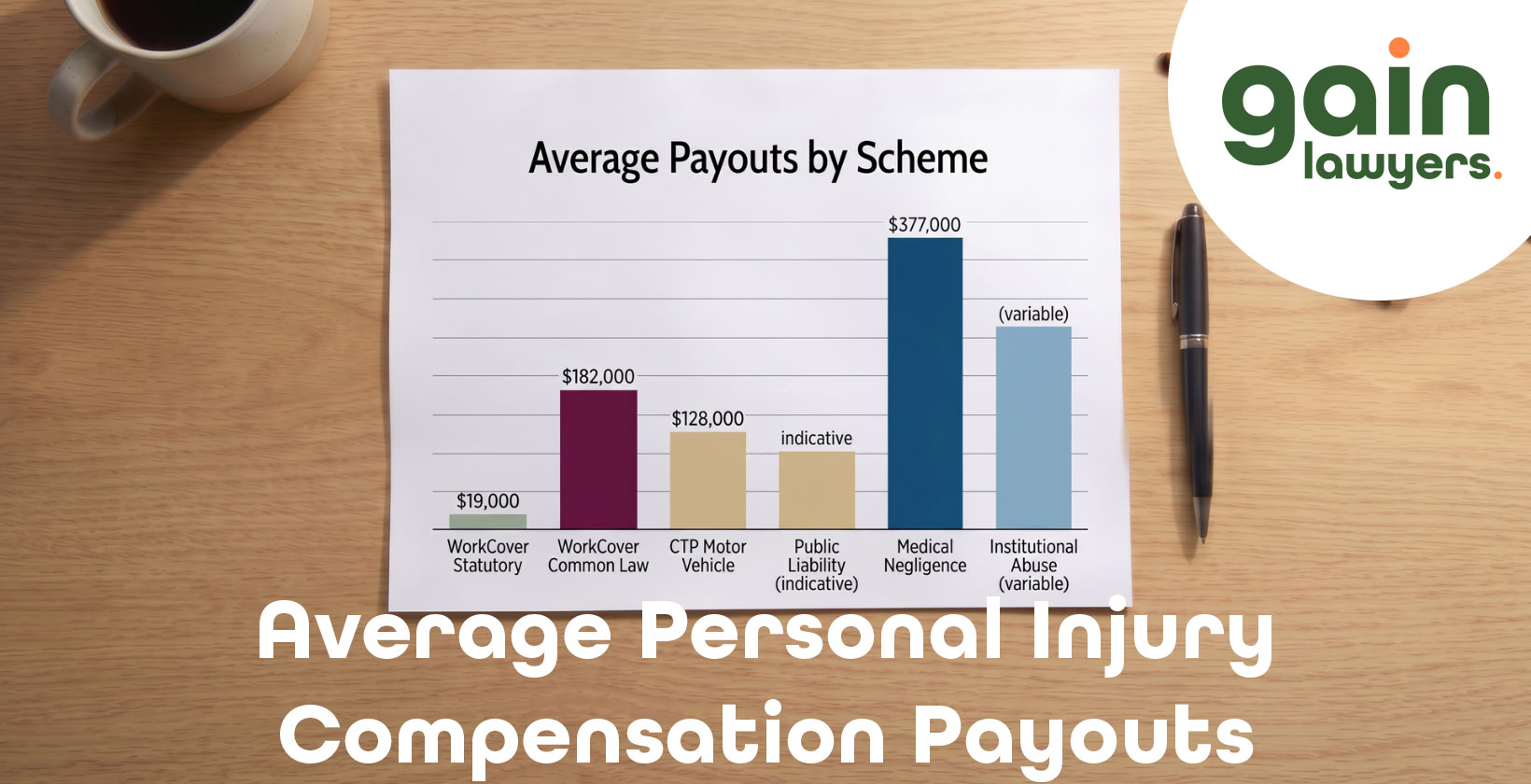
Average personal injury compensation payouts in Queensland range from approximately $19,253 for a WorkCover statutory claim to $377,707 for a medical negligence claim against Queensland public health, depending on which compensation scheme applies. Personal injury compensation in Queensland is administered through six separate schemes - Compulsory Third Party (CTP) motor vehicle accident, WorkCover statutory and WorkCover common law, public liability, medical negligence, and institutional abuse claims - alongside contractual and statutory frameworks for Total and Permanent Disability (TPD) insurance and Department of Veterans' Affairs (DVA) compensation. Each scheme produces fundamentally different compensation payouts for the same injury, which is why a single cross-scheme "average payout" figure does not exist.
WorkCover common law settlements average $182,296 and CTP motor vehicle accident claims average $128,300 across all severities, according to Office of Industrial Relations and Motor Accident Insurance Commission data. WorkCover statutory claims are the lowest of the main streams because statutory benefits replace specific costs (weekly wages, medical expenses, permanent impairment lump sums) rather than awarding damages for the full range of losses.
Within the CTP scheme, injury severity is the biggest single determinant of compensation amount. Motor Accident Insurance Commission severity-banded data shows minor injury averages of $88,900 rising to $859,100 for critical injuries - a 9.7x spread within the same scheme. Similar severity-driven dispersion is seen in WorkCover common law settlements, public liability claims, and medical negligence claims, even though those schemes do not publish severity-banded statistics. Catastrophic injury claims with permanent loss of work capacity and lifetime care needs can exceed $1 million in total compensation across every Civil Liability Act scheme. The Civil Liability Act 2003 governs general damages for most Queensland personal injury claims through the Injury Scale Value (ISV) system, with maximum awards of $484,100 at ISV 100 under the Civil Liability Indexation Notice 2025.
Key statistics
Key statistics
Average payout by compensation scheme
- $377,707 average for medical negligence claims against Queensland public health (2018-2023)
- $182,296 average for WorkCover common law settlements (2024-25)
- $128,300 average for CTP motor vehicle accident claims across all severities (2024-25)
- $19,253 average per WorkCover statutory claim across all benefit types (2023-24)
CTP severity-banded averages (the only published severity data in Queensland)
- $88,900 minor injuries (AIS 1) - 73% of all CTP claims
- $195,600 moderate injuries (AIS 2)
- $372,800 serious injuries (AIS 3)
- $698,700 severe injuries (AIS 4)
- $859,100 critical injuries (AIS 5)
Maximum general damages
- $484,100 at ISV 100 for CTP, public liability and medical negligence claims (Civil Liability Indexation Notice 2025, effective 1 July 2025)
- $468,360 at ISV 100 for WorkCover common law claims (Schedule 17 of the Workers' Compensation and Rehabilitation Regulation 2025, calculated as 239.71 × QOTE of $1,953.70 per week, effective 1 July 2025)
Scheme volumes (latest published)
- 8,843 CTP claims finalised in 2024-25 across $1.135 billion in total payments
- 3,753 new WorkCover common law claims lodged in 2024-25
- 98,643 new WorkCover statutory claims lodged in 2023-24
- 1,049 medical negligence claims settled by Queensland public health 2018-2023
Last updated: May 2026. Data current to financial year ending 30 June 2025 except where stated.
The table below summarises the average payouts, severity ranges, and fault requirements for each Queensland personal injury compensation scheme, as a reference point before the scheme-by-scheme detail later on this page.
Source: Gain Lawyers analysis of Motor Accident Insurance Commission CTP Personal Injury Register (2024-25), Office of Industrial Relations Queensland workers' compensation scheme statistics 2023-24 (published December 2024), Queensland Health Right to Information data reported by ABC News (May 2024), Australian Prudential Regulation Authority life insurance claims and disputes statistics (2023), and Department of Veterans' Affairs published payment rates effective 1 July 2025. "Not published" indicates no Queensland-specific scheme-wide average is available; indicative ranges are based on practitioner experience and severity-driven dispersion observed in published CTP and medical negligence data.
What is the average personal injury compensation payout in Queensland?
The average personal injury compensation payout in Queensland ranges from approximately $19,253 for a WorkCover statutory claim to $377,707 for a medical negligence claim against Queensland public health, depending on which compensation scheme applies. CTP motor vehicle accident claims average $128,300 across all severities, and WorkCover common law settlements average $182,296, based on the most recent published data from the Motor Accident Insurance Commission, the Office of Industrial Relations, and Right to Information data released to ABC News in 2024.
There is no single Queensland-wide "average personal injury payout" figure because personal injury compensation is administered through six separate schemes, each with its own legislative framework, valuation methodology, and published data. The accurate framework for estimating a personal injury compensation payout combines the applicable scheme, the injury severity, and the claimant-specific factors covered later on this page.
Why is there no single average personal injury payout figure in Queensland?
There is no single average personal injury payout figure in Queensland because personal injury compensation is administered through six separate schemes with different legislative frameworks. CTP motor vehicle accident claims are paid through the Compulsory Third Party scheme regulated by the Motor Accident Insurance Commission (MAIC) under the Motor Accident Insurance Act 1994. WorkCover Queensland claims are paid under the Workers' Compensation and Rehabilitation Act 2003, which produces separate statutory and common law payouts. Public liability and medical negligence claims are governed by the Civil Liability Act 2003. Institutional abuse claims can proceed under the National Redress Scheme (a federal statutory scheme) or as common law civil claims. Total and Permanent Disability (TPD) insurance claims and Department of Veterans' Affairs (DVA) compensation operate as contractual benefits and statutory entitlements respectively, outside the personal injury damages framework.
Each scheme produces fundamentally different compensation payouts for the same injury. A worker injured in a workplace accident accesses statutory benefits worth around $19,253 on average, but if employer negligence can be established the same worker can pursue a common law claim averaging $182,296. A medical negligence claim against Queensland public health averages $377,707 because the average claim involves more serious injury than a typical workers' compensation accepted claim. The 30x spread between WorkCover statutory and Queensland public health medical negligence averages reflects scheme architecture rather than injury severity.
Scheme-wide averages are also distorted by claim volume at each end of the severity spectrum. The MAIC's overall CTP average of $128,300 is heavily weighted by the 73% of CTP claims classified as minor injuries, which pulls the average down. A claimant with a moderate fracture or a serious spinal injury should not expect a payout near $128,300, because severity-specific averages are a more accurate reference.
How does injury severity affect compensation payouts?
Injury severity affects compensation payouts by driving the value of every head of damage simultaneously, producing a 9.7x spread between minor injury averages of $88,900 and critical injury averages of $859,100 within the CTP scheme alone. More severe injuries produce higher Injury Scale Value ratings (and therefore higher general damages), longer treatment requirements, greater care needs, and more substantial economic loss.
The CTP scheme is the only Queensland personal injury scheme that publishes detailed severity-banded payout statistics. The Motor Accident Insurance Commission uses the Abbreviated Injury Scale (AIS) to classify CTP claims by severity, with the following published averages for 2024-25:
- Minor injuries (AIS 1): $88,900 average
- Moderate injuries (AIS 2): $195,600 average
- Serious injuries (AIS 3): $372,800 average
- Severe injuries (AIS 4): $698,700 average
- Critical injuries (AIS 5): $859,100 average
These figures are based on 8,843 CTP claims finalised in 2024-25. The 9.7x spread between the minor and critical injury averages within a single scheme is wider than the spread between most schemes, which means injury severity is a bigger determinant of compensation amount than which scheme applies in most cases.
Similar severity-driven dispersion is seen in WorkCover common law settlements, public liability claims, and medical negligence claims, even where those schemes do not publish severity-banded statistics. Settlement size in those schemes correlates with injury severity for the same reasons it does in CTP claims: greater economic loss, longer treatment, and higher care needs. Catastrophic injury claims with permanent loss of work capacity and lifetime care needs can exceed $1 million in total compensation across CTP, WorkCover common law, public liability, and medical negligence claims.
Source: Motor Accident Insurance Commission, CTP Personal Injury Register - Injury Severity Costs Breakdown (finalised claims 1 July 2024 to 30 June 2025).
Why are single-figure payout lists by injury type misleading?
Single-figure payout lists by injury type are misleading because the same injury produces fundamentally different compensation payouts depending on which scheme applies, the claimant's age and earning capacity, and the severity of the specific injury within that injury type. A lumbar muscle strain and a spinal cord injury are both "back injuries", but the compensation difference between them is more than tenfold.
Several Queensland law firm websites publish "lists of compensation payouts" showing single dollar figures by injury type, such as "fractures: $39,952" or "back injuries: $74,000". These figures are often misleading when presented without scheme, severity, and claimant context.
A second reason single-figure injury lists are unreliable is that Queensland compensation schemes do not value injuries through fixed dollar amounts. The Civil Liability Act 2003 governs general damages (the legal term for pain and suffering) for most Queensland personal injury claims through the Injury Scale Value (ISV) system. The ISV assigns a value from 0 to 100 to each injury, where 0 indicates an injury too minor to attract general damages and 100 represents the most serious injury possible. The maximum general damages award at ISV 100 is $484,100 for CTP, public liability, and medical negligence claims under the Civil Liability Indexation Notice 2025, and $468,360 for WorkCover common law claims under Schedule 17 of the Workers' Compensation and Rehabilitation Regulation 2025.
General damages account for approximately 12% of total payments at the scheme level in Motor Accident Insurance Commission CTP data for 2024-25. Economic loss accounts for approximately 50% and care, treatment, and special damages account for the remaining 38%. A single-figure injury list that quotes general damages alone is therefore presenting only a small slice of the typical payout. The accurate framework for estimating a personal injury compensation payout combines the applicable scheme, the injury severity, and the claimant-specific factors covered later on this page.
Key findings:
- There is no single Queensland-wide average personal injury payout figure because compensation is administered through six separate schemes with different legislative frameworks and valuation methodologies
- Injury severity produces a 9.7x difference in average payouts within the CTP scheme, and similar severity-driven dispersion is seen across WorkCover, public liability, and medical negligence claims
- Single-figure "list of payouts by injury type" articles published by competitor law firms are often misleading because they typically quote general damages alone, which represents only around 12% of the average total payout in CTP data
What are the average payouts by Queensland personal injury compensation scheme?
Average payouts by Queensland personal injury compensation scheme vary substantially, from approximately $19,253 for a WorkCover statutory claim to $377,707 for a Queensland public health medical negligence claim. Compulsory Third Party (CTP) motor vehicle accident claims average $128,300 across all severities. WorkCover common law settlements average $182,296. Public liability claims, institutional abuse claims, Total and Permanent Disability (TPD) insurance payouts, and Department of Veterans' Affairs (DVA) compensation amounts vary based on scheme-specific valuation methods explained below.
The figures below represent scheme-wide averages, which include both minor and catastrophic claims. Severity-specific figures are a more accurate reference for any individual claim, but most schemes do not publish severity-banded statistics. Where published data exists, severity-banded averages are included in the scheme-specific sub-sections below.
Average payout for a motor vehicle accident claim in Queensland
The average CTP motor vehicle accident compensation payout in Queensland is $128,300 across all severities, with severity-specific averages ranging from $88,900 for minor injuries to $859,100 for critical injuries. These figures are based on 8,843 finalised CTP claims in the 2024-25 financial year.
Typical payout ranges by severity within the CTP scheme run from $88,900 (minor, AIS 1) to $195,600 (moderate, AIS 2), $372,800 (serious, AIS 3), $698,700 (severe, AIS 4), and $859,100 (critical, AIS 5). CTP claims are paid by the at-fault driver's CTP insurer through the Queensland Compulsory Third Party scheme, regulated by the Motor Accident Insurance Commission (MAIC) under the Motor Accident Insurance Act 1994. CTP insurance is mandatory for every registered vehicle in Queensland and covers personal injury caused by the driver's negligence. The scheme is fault-based, which means an injured person must establish that another road user caused or contributed to the accident.
CTP payouts include all heads of damage permitted under the Civil Liability Act 2003: general damages (pain and suffering), past and future economic loss, past and future treatment costs, past and future care, and special damages. Economic loss accounts for approximately 50% of the average CTP payout, general damages account for approximately 12%, and care, treatment, and other heads account for the remaining 38%. The MVA cluster sets out a more detailed severity-band-by-severity-band breakdown, including claim volumes, total scheme payments, and body region splits, on the average motor vehicle accident compensation payouts QLD page.
Source: Motor Accident Insurance Commission, CTP Personal Injury Register - Injury Severity Costs Breakdown and Heads of Damage Breakdown (finalised claims 1 July 2024 to 30 June 2025).
Average payout for a WorkCover statutory claim in Queensland
The average WorkCover Queensland statutory claim paid $19,253 per claim across all benefit types in 2023-24, calculated from total statutory payments of $1.9 billion across 98,643 new claims. WorkCover statutory claim payouts are highly variable because the figure aggregates weekly compensation, medical and rehabilitation expenses, and lump sum permanent impairment payments across all accepted claims regardless of severity.
Typical payout ranges sit toward the lower end of the personal injury compensation spectrum because statutory benefits compensate specific losses (lost wages, medical bills, permanent impairment) rather than awarding damages for the full impact of an injury. WorkCover statutory claims are paid through the Queensland workers' compensation scheme under the Workers' Compensation and Rehabilitation Act 2003. The scheme is no-fault, which means an injured worker is eligible for statutory benefits regardless of who caused the injury, provided the injury arose out of or in the course of employment.
Statutory benefits include weekly compensation for lost wages, medical and rehabilitation expenses, and a lump sum payment for permanent impairment based on a Whole Person Impairment (WPI) percentage assessed by an independent medical examiner. Permanent impairment lump sums for statutory claims typically range from $4,000 to $40,000 depending on the WPI percentage assessed. Statutory benefits do not include general damages for pain and suffering. A worker seeking general damages must instead pursue a separate WorkCover common law claim against the employer.
Source: Office of Industrial Relations, Queensland workers' compensation scheme statistics 2023-24 (published December 2024).
Average payout for a WorkCover common law claim in Queensland
The average WorkCover common law settlement in Queensland was $182,296 in 2024-25, based on finalised damages settlements under the Queensland workers' compensation scheme. The 2023-24 average was $187,656 and the 2022-23 average was $188,528, indicating a small year-on-year decline. WorkCover Queensland finalised over 3,200 common law claims in 2022-23 and recorded 3,753 new common law claims lodged in 2024-25.
Typical payout ranges for WorkCover common law claims are broad and severity-driven, with minor injury settlements falling well below the average and catastrophic injury claims regularly reaching seven figures. WorkCover common law claims are negligence-based damages claims against the employer, brought under the Workers' Compensation and Rehabilitation Act 2003 and assessed under the same general principles as other personal injury negligence claims. The worker must establish that the employer breached its duty of care and that the breach caused the injury.
A WorkCover common law claim is generally only available where the worker's Whole Person Impairment (WPI) assessment meets the relevant statutory threshold (commonly 20%), or where the worker chooses to relinquish their statutory entitlements to pursue common law. Eligibility is governed by the detailed provisions of the Workers' Compensation and Rehabilitation Act 2003 and is more nuanced than a single threshold suggests. Common law settlements include all heads of damage: general damages calculated using the Injury Scale Value (ISV) system under Schedule 17 of the Workers' Compensation and Rehabilitation Regulation 2025, past and future economic loss, treatment, care, and special damages. Common law settlement averages exclude nil settlements (the 2022-23 figure excluded 444 nil settlements) and represent damages awards only, not the worker's prior statutory benefits.
Source: Office of Industrial Relations, Queensland workers' compensation scheme statistics 2023-24 (published December 2024).
Average payout for a public liability claim in Queensland
Queensland does not publish a scheme-wide average for public liability claim payouts, because public liability claims do not flow through a single statutory scheme and individual settlements are typically subject to confidentiality agreements that prevent disclosure of dollar figures. The most authoritative national dataset is the Australian Prudential Regulation Authority (APRA) National Claims and Policies Database, which captures every public liability claim underwritten by APRA-regulated general insurers since 2003, but APRA does not publish Queensland-specific average payout figures by claim type.
Public liability claims are damages claims for personal injury caused by negligence in a public space, on private property accessible to the public, or by a defective product. Common scenarios include slips and falls in shopping centres, supermarkets, and licensed premises; injuries on rental properties; injuries at hotels and resorts; and injuries caused by defective products. Public liability claims are governed by the Civil Liability Act 2003 and are paid by the negligent party's public liability insurer.
Public liability payouts include all heads of damage available under the Civil Liability Act 2003: general damages calculated using the Injury Scale Value (ISV) system, past and future economic loss, treatment, care, and special damages. Because public liability claims share the same legislative framework as CTP and medical negligence claims, the severity-driven payout dispersion observed in CTP data is a reasonable analogue for public liability outcomes. Indicative ranges suggest a minor slip resulting in soft tissue injury commonly falls in the tens of thousands (often $20,000 to $80,000), while serious public liability claims involving spinal injury, traumatic brain injury, or permanent disability commonly exceed $500,000 and can reach $2 million or more. These ranges are indicative based on practitioner experience and the severity-driven dispersion observed in published CTP and medical negligence data, not derived from a published Queensland-specific public liability dataset.
Average payout for a medical negligence claim in Queensland
The average medical negligence payout against Queensland public health was $377,707 across 1,049 settled claims between January 2018 and October 2023, as reported by ABC News in May 2024 based on Queensland Health Right to Information documents. Total payouts across the period were $396.1 million, paid by Queensland Health Hospital and Health Services through their indemnity arrangements.
Typical payout ranges are highly severity-driven. Minor medical negligence claims involving short-term complications fall in the $50,000 to $200,000 range, while catastrophic claims involving birth injuries with lifetime care needs, permanent neurological damage, or wrongful death commonly exceed $1 million and can reach $5 million or more in extreme cases. Medical negligence claims are damages claims for personal injury caused by a medical practitioner's failure to exercise the standard of care reasonably expected of a competent practitioner in the relevant specialty. Common medical negligence claim types include misdiagnosis, surgical errors, birth injuries, medication errors, and failure to obtain informed consent.
Medical negligence claims are governed by the Civil Liability Act 2003 and the Personal Injuries Proceedings Act 2002, which sets out specific procedural requirements including a mandatory pre-litigation expert opinion under section 9A. The $377,707 figure covers public health claims only. Private medical negligence claims (against private hospitals, specialists in private practice, GPs, and allied health practitioners) are not captured in any published Queensland dataset. Most private medical negligence settlements involve confidentiality agreements that prevent public disclosure.
Average payout for an institutional abuse claim in Queensland
Institutional abuse claims in Queensland proceed through two distinct compensation pathways with very different payout structures. The National Redress Scheme provides statutory payments capped at $150,000 per applicant. Common law civil claims against institutions are not subject to a statutory cap and produce indicative payouts ranging from approximately $50,000 for less severe abuse to several million dollars for severe abuse with significant ongoing psychological harm, with higher amounts possible in extreme cases involving lifetime impact.
The National Redress Scheme is a federal statutory scheme established in response to the Royal Commission into Institutional Responses to Child Sexual Abuse. The scheme provides three forms of redress: a monetary payment of up to $150,000, a counselling and psychological care component, and a direct personal response from the responsible institution. The scheme is administered by the Department of Social Services and is available to people who experienced sexual abuse in institutional contexts before 1 July 2018.
Common law civil claims for institutional abuse proceed as personal injury negligence claims, typically against the institution responsible for the abuse and sometimes against insurers, dioceses, or successor entities. These claims are governed by the Civil Liability Act 2003 (with specific exceptions for child abuse claims under the Limitation of Actions Act 1974, which removed the limitation period for child sexual abuse claims). No published Queensland-specific dataset captures average civil settlement amounts because most settlements are confidential. Civil claims typically produce significantly higher payouts than the National Redress Scheme cap, particularly where the abuse was severe, prolonged, or caused lasting psychiatric injury affecting work capacity.
Average payout for a TPD insurance claim
Total and Permanent Disability (TPD) insurance claims typically pay between $60,000 and $300,000 for individual policies, with claims under default group cover within superannuation funds usually falling in the $50,000 to $200,000 range depending on age and account balance. Advised TPD claims sold through retail individual policies average approximately $785,000, but this figure reflects a specific retail market segment with much higher insured sums and is not representative of typical TPD outcomes for the broader insured population. APRA reported a TPD acceptance rate of 92.3% across all insurers in June 2023.
TPD payouts operate fundamentally differently from personal injury damages claims. TPD is a contractual insurance benefit payable by a life insurer when the insured satisfies the policy's definition of total and permanent disability. The payout amount is fixed by the insured sum specified in the policy, not assessed by reference to economic loss, treatment costs, or general damages. TPD insurance claims do not require any party to be at fault.
TPD coverage is most commonly held through default group cover within superannuation funds. Individual TPD policies (held outside superannuation) often have higher insured sums. A TPD payout is typically paid into the claimant's superannuation account if the cover is held through super, then released subject to a "condition of release" assessment by the trustee. Tax may be payable depending on age and how the benefit is taken.
Source: Australian Prudential Regulation Authority, Life insurance claims and disputes statistics, June 2023.
Average payout for a DVA compensation claim
Department of Veterans' Affairs (DVA) compensation operates through a statutory entitlement system rather than published average payouts, with payments calculated by reference to impairment points (not the Injury Scale Value system used in civil claims). DVA pays current and former Australian Defence Force members for service-related injuries, illnesses, and conditions through three separate schemes: MRCA, DRCA, and VEA.
Under the Military Rehabilitation and Compensation Act 2004 (MRCA), the maximum weekly Permanent Impairment payment is $431.84 per week as at 1 July 2025, with a lump sum equivalent of up to $111,173.19 for severely impaired veterans with dependants. Under the Veterans' Entitlements Act 1986 (VEA), the Special Rate Disability Pension pays a maximum of $947.95 per week. Veterans may also be eligible for incapacity payments, treatment under the DVA Gold Card or White Card, and rehabilitation services. DVA payment rates are updated quarterly.
Source: Department of Veterans' Affairs, Compensation payment rates effective 1 July 2025.
Key findings:
- Average payouts vary by approximately 30x across Queensland personal injury compensation schemes, from around $19,253 for a WorkCover statutory claim to $377,707 for a Queensland public health medical negligence claim, with significant within-scheme variation by injury severity
- CTP, public liability, medical negligence, and WorkCover common law claims all use the ISV system for general damages but produce different payout averages because of different claim volumes, severity profiles, and economic loss profiles
- TPD and DVA compensation operate outside the personal injury damages framework and produce payouts based on contractual insured sums and statutory entitlement schedules respectively, rather than negligence-based damages assessment
What components make up a personal injury compensation payout?
A personal injury compensation payout in Queensland is *made up of six categories called "heads of damage" under the Civil Liability Act 2003***. The six heads of damage are: general damages (compensation for pain and suffering), past and future economic loss (lost wages and reduced earning capacity), past and future treatment expenses, past and future care, special damages (out-of-pocket expenses), and interest on past losses. The same six heads of damage apply across all Civil Liability Act personal injury claims in Queensland.
The relative weight of each head of damage in CTP claim payouts is shown in the table below, based on Motor Accident Insurance Commission Heads of Damage data for 2024-25. These proportions reflect the CTP scheme specifically; proportions vary across other schemes depending on claim type and severity, although a similar pattern (economic loss largest, general damages a relatively small share) is observed in negligence-based claims more generally.
Source: Motor Accident Insurance Commission, CTP Personal Injury Register - Heads of Damage Breakdown (finalised claims 1 July 2024 to 30 June 2025). Percentages are share of total scheme payments across $1.135 billion in finalised CTP claims.
Economic loss and care between them account for approximately 68% of the average CTP payout in Queensland. General damages, despite being the most well-known head of damage publicly, account for only around 12% of the average total payout in MAIC CTP data. This is one of the reasons that single-figure "list of payouts by injury type" articles are misleading: they often quote general damages figures (a small slice of the payout) as if they represented the whole compensation amount.
The same six heads of damage apply across all Civil Liability Act personal injury claims in Queensland, including CTP motor vehicle accident claims, public liability claims, medical negligence claims, and WorkCover common law claims. WorkCover statutory claims, Total and Permanent Disability (TPD) insurance claims, and Department of Veterans' Affairs (DVA) compensation use different valuation frameworks explained in the scheme breakdown above.
How are general damages (pain and suffering) calculated?
General damages in Queensland are calculated by applying the Injury Scale Value (ISV) system, which assigns a value from 0 to 100 to each injury and converts the value to a dollar figure under the relevant indexation notice or regulation. General damages compensate the injured person for the non-financial impact of the injury, including pain, suffering, loss of amenities of life, and loss of expectation of life.
The maximum general damages award at ISV 100 is $484,100 for CTP, public liability, and medical negligence claims under the Civil Liability Indexation Notice 2025, and $468,360 for WorkCover common law claims under Schedule 17 of the Workers' Compensation and Rehabilitation Regulation 2025. The two schemes use different calculation mechanisms: the Civil Liability framework uses banded base-and-variable amounts that are indexed annually, and the WorkCover framework uses fixed multipliers of Queensland Ordinary Time Earnings (QOTE) that adjust automatically as QOTE updates each financial year. General damages average approximately 12% of total compensation in CTP claims, according to MAIC Heads of Damage data for 2024-25.
A claimant's ISV is determined by reference to the dominant injury, the level of pain experienced, the extent of any permanent impairment, the psychological impact of the injury, and the effect of the injury on the injured person's ability to carry out daily activities and employment. The factors are set out in Schedule 4 of the Civil Liability Regulation 2025 for Civil Liability Act claims and Schedule 14 of the Workers' Compensation and Rehabilitation Regulation 2025 for WorkCover common law claims. Queensland's Injury Scale Value (ISV) system replaced the common law approach to general damages in December 2002, with the goal of producing more consistent compensation outcomes for similar injuries.
How is economic loss calculated?
Economic loss in Queensland is calculated by separating past economic loss (lost income up to the date of settlement) from future economic loss (reduced earning capacity from the date of settlement to retirement age), then applying scheme-specific caps and discounting to convert future losses into a present-day lump sum. Economic loss is the largest single head of damage in most personal injury compensation payouts and accounts for approximately 50% of the average CTP claim payout, according to MAIC Heads of Damage data for 2024-25.
Past economic loss covers lost wages, lost overtime, lost bonuses and commissions, and lost employer superannuation contributions on the lost earnings between the date of injury and the date of settlement. It is the most directly verifiable component because it is established using the injured person's pre-accident earnings, evidence of time off work, and tax returns or payslips.
Future economic loss covers reduced earning capacity from the date of settlement to retirement age and is typically the most contested head of damage. Future economic loss forms a substantial basis for how personal injury compensation is calculated in Queensland. The calculation involves a medical opinion on the injured person's residual work capacity, a vocational assessment of likely future earnings with and without the injury, and an actuarial calculation that converts the projected weekly loss into a present-day lump sum.
Lost employer superannuation contributions on future lost earnings are claimable as a separate component, calculated at the relevant Superannuation Guarantee rate. Economic loss is particularly significant for younger claimants and those with serious or permanent injuries affecting work capacity, because the claim represents lifetime financial loss.
How are care, treatment, and special damages compensated?
Care, treatment, and special damages are compensated by quantifying the actual past costs incurred and using medical and occupational therapy opinions to project future needs into a present-day lump sum. These three heads of damage together account for approximately 38% of the average CTP claim payout, according to MAIC Heads of Damage data for 2024-25.
The three components are compensated as follows:
- Past and future treatment expenses. Past and future treatment expenses cover the cost of medical and rehabilitation treatment caused by the injury, including ongoing physiotherapy, future surgery, psychological counselling, and specialist medication. Future treatment is calculated using a medical opinion on the injured person's likely ongoing treatment needs over their lifetime.
- Past and future care. Past and future care covers any care and assistance provided to the injured person by family members, friends, or professional carers. Gratuitous care (unpaid care provided by family or friends) is compensable in Queensland under the Civil Liability Act 2003 subject to threshold requirements set out in section 59. Catastrophic injury claims involving lifetime care needs (such as severe traumatic brain injury or spinal cord injury) often have future care costs that exceed every other head of damage combined, sometimes reaching several million dollars and accounting for most of the total compensation amount.
- Special damages and interest. Special damages cover out-of-pocket expenses caused by the injury, including travel costs to medical appointments, the cost of medical aids and equipment, home modifications such as wheelchair access or bathroom adaptations, and vehicle modifications. Interest on past losses (general damages excluded) is added at settlement under the Civil Proceedings Act 2011.
Key findings:
- The six heads of damage that make up a Queensland personal injury compensation payout are general damages, past and future economic loss, past and future treatment expenses, past and future care, special damages, and interest, with economic loss and care together accounting for approximately 68% of the average CTP payout
- General damages (pain and suffering) account for only approximately 12% of the average personal injury compensation payout in CTP data, despite being the most publicly recognised head of damage
- Catastrophic injury claims involving lifetime care needs often have future care costs that exceed every other head of damage combined, which is the primary driver of compensation amounts above $1 million
What factors affect how much personal injury compensation you receive?
Six primary factors determine how much personal injury compensation a claimant receives in Queensland: which compensation scheme applies, the severity and permanence of the injury, the claimant's economic loss profile, contributory negligence, pre-existing conditions, and whether the claimant has legal representation.
The six factors are as follows:
- Which compensation scheme applies. The single biggest determinant of compensation amount is the scheme governing the claim. Compulsory Third Party (CTP), WorkCover statutory, WorkCover common law, public liability, medical negligence, abuse, Total and Permanent Disability (TPD), and Department of Veterans' Affairs (DVA) compensation each use different valuation frameworks that produce fundamentally different payouts for the same injury.
- Injury severity and permanence. Injury severity is the strongest within-scheme determinant of compensation amount. Severity affects every head of damage: more severe injuries produce higher Injury Scale Value (ISV) ratings (and therefore higher general damages), longer treatment requirements, greater care needs, and more substantial economic loss.
- Economic loss factors. The claimant's age, occupation, pre-accident earnings, and residual work capacity drive the economic loss component, which is typically the largest head of damage. A 30-year-old earning $90,000 with permanent loss of work capacity has a much larger future economic loss claim than a 60-year-old earning $50,000 with the same injury, because future economic loss is calculated to retirement age.
- Contributory negligence. If the claimant contributed to the cause of the injury (for example, by failing to wear a seatbelt, walking into a clearly hazardous area, or ignoring a warning sign), the compensation amount is reduced by the percentage of fault attributed to the claimant. Reductions of 20% to 50% are common in cases involving contributory negligence.
- Pre-existing conditions. Pre-existing injuries or medical conditions can reduce compensation if they would have produced the same impairment regardless of the accident. The legal test is whether the injury aggravated or accelerated a pre-existing condition. Where the pre-existing condition would have produced the same outcome anyway, the compensation is reduced or eliminated for that aspect of the claim.
- Legal representation. Claimants represented by lawyers receive significantly higher compensation amounts than self-represented claimants on average. Motor Accident Insurance Commission CTP data shows legally represented claimants receive average payouts approximately 11 times higher than self-represented claimants, although the gap reflects both the negotiation leverage of legal representation and the fact that more complex (and therefore higher-value) claims are more likely to be legally represented.
Does having a lawyer affect personal injury compensation amounts?
Yes, having a lawyer does affect personal injury compensation amounts. Claimants with legal representation receive substantially higher personal injury compensation payouts than self-represented claimants in Motor Accident Insurance Commission CTP data, with represented CTP motor vehicle accident claimants receiving average payouts of approximately $90,000 compared with approximately $8,000 for self-represented claimants - a difference of more than 11 times in the dataset reviewed.
The size of the gap reflects several factors and is not solely driven by representation itself. Legally represented claimants tend to have more serious injuries and more complex claims, which would attract higher payouts regardless of representation. This selection bias accounts for a significant portion of the headline gap. Lawyers also have access to expert witnesses (medical specialists, occupational therapists, vocational assessors, and forensic accountants) who can substantiate the full extent of an injured person's losses, particularly for future economic loss and future care, which insurers tend to underestimate when negotiating with self-represented claimants.
Most Queensland personal injury lawyers operate on a no win no fee basis, which means the claimant pays no legal fees if the claim is unsuccessful and pays legal fees out of the settlement if the claim succeeds. Legal fees on a successful claim are typically capped under the Legal Profession Act 2007 and the Personal Injuries Proceedings Act 2002 (the "50/50 rule" prevents legal fees from exceeding 50% of the net settlement amount in most cases). Net of legal fees, legally represented claimants in Queensland still typically receive significantly higher amounts than self-represented claimants would have received.
Is there a maximum personal injury compensation amount in Queensland?
No, there is no overall maximum personal injury compensation amount in Queensland, but individual heads of damage are subject to caps and thresholds that limit specific components of the payout. Total compensation payouts in Queensland have ranged from $0 (where claims are unsuccessful or fully apportioned to contributory negligence) to over $20 million (for catastrophic claims involving lifetime care needs and lost lifetime earnings).
The most significant statutory cap is the maximum on general damages (pain and suffering). For Civil Liability Act claims (CTP, public liability, and medical negligence), the maximum general damages award is $484,100 at ISV 100 under the Civil Liability Indexation Notice 2025. For WorkCover common law claims, the maximum is $468,360 under Schedule 17 of the Workers' Compensation and Rehabilitation Regulation 2025. Both maxima are indexed annually.
Other statutory restrictions affect specific heads of damage. Future economic loss is subject to a cap of three times the average weekly earnings under section 54 of the Civil Liability Act 2003. Gratuitous care is only compensable where the care is provided for at least 6 hours per week and at least 6 months. Interest on past general damages is excluded by section 60 of the Civil Liability Act. None of these restrictions impose an overall maximum on the total compensation amount, which remains determined by the actual financial losses the injured person can establish.
Are personal injury compensation payouts taxable?
No, as a general rule personal injury compensation payouts in Queensland are not taxable when received as a lump sum settlement or court-awarded damages, although there are important exceptions. The Australian Taxation Office (ATO) does not treat personal injury damages as assessable income because they compensate the injured person for a loss rather than constituting earnings.
The tax treatment of personal injury claims in Queensland applies to CTP settlements, WorkCover common law settlements, public liability settlements, medical negligence settlements, and institutional abuse settlements. The exemption covers the entire lump sum, including the components representing economic loss (which would have been taxable as income if earned in the normal course).
The exceptions and qualifications matter. Interest earned on the lump sum after settlement (for example, if the lump sum is invested) is taxable in the normal way. WorkCover statutory weekly compensation payments are taxable as income, because they directly replace wages on a periodic basis rather than constituting damages. TPD insurance payouts paid into superannuation may attract tax depending on the claimant's age and how the benefit is taken. Structured settlements (where compensation is paid in periodic instalments rather than a single lump sum) are tax-exempt under the Income Tax Assessment Act 1997 (Cth) provided specific statutory conditions are met.
Can you claim personal injury compensation if you were partly at fault?
Yes, you can claim personal injury compensation in Queensland if you were partly at fault, but the compensation amount is reduced by the percentage of fault attributed to you. This principle is called contributory negligence and is set out in the Law Reform Act 1995 and the Civil Liability Act 2003.
Contributory negligence applies whenever the claimant's own conduct contributed to the cause of the injury, even where another party is primarily responsible. Common examples include failing to wear a seatbelt in a motor vehicle accident, riding a bicycle without a helmet, walking into a clearly hazardous area despite warning signs, working on equipment without using available safety devices, or accepting a lift from a driver known to be intoxicated. Reductions of 20% to 50% are common in cases involving contributory negligence, and reductions of 100% (which extinguish the claim entirely) are possible in extreme cases.
Special rules apply in CTP motor vehicle accident claims under the Civil Liability Act 2003. Failure to wear a seatbelt or other restraint produces a mandatory minimum 25% reduction. Driving with a blood alcohol concentration over the legal limit produces a mandatory minimum 25% reduction (which can be increased depending on the circumstances). These statutory minimums apply even where the claimant's contribution to the cause of the accident is otherwise minor.
How long does a personal injury compensation claim take to settle?
Most personal injury compensation claims in Queensland take between 12 and 24 months to settle, although complex claims involving severe injuries or disputed liability can take 3 to 5 years or longer. The typical timeline depends on the compensation scheme, the complexity of the medical evidence, and whether liability is in dispute.
CTP motor vehicle accident claims typically take 18 to 36 months from the date of accident to settlement. The MAIC scheme requires the claimant to lodge a Notice of Accident Claim Form within 9 months of the accident, after which the CTP insurer has 6 months to admit or deny liability and obtain medical evidence. A mandatory Compulsory Conference is held before either party can commence court proceedings, and most claims settle at or shortly after the conference.
WorkCover common law claims typically take 12 to 24 months, but require the worker to first reach maximum medical improvement (the point where the injury has stabilised) before the claim can be properly valued. Public liability and medical negligence claims under the Personal Injuries Proceedings Act 2002 require the claimant to give an Initial Notice and obtain a supporting expert opinion before proceedings can commence, which typically adds 3 to 6 months to the timeline. Claims that miss the strict statutory time limits for personal injury claims in Queensland may be barred entirely, even where the underlying injury is severe. Catastrophic claims involving traumatic brain injury, spinal cord injury, or severe psychiatric injury typically take longer because the long-term prognosis takes years to establish, and settlements before maximum medical improvement risk under-compensating the injured person.
Are personal injury compensation calculators accurate?
It depends. Personal injury compensation calculators vary widely in accuracy, with most providing rough estimates that should not be relied on as a substitute for a professional case assessment. The accuracy of any individual calculator depends on how transparently it models the factors that drive a personal injury payout, how clearly it communicates its limitations, and whether it accounts for scheme-specific differences in valuation methodology.
A more fundamental limitation is that calculators rely on self-assessment by the user. Inputs such as injury severity, residual work capacity, expected future treatment, and pre-existing conditions are difficult for a non-expert to assess accurately, and small errors at the input stage produce large errors in the output. A claimant who under-assesses their long-term work capacity loss will see an underestimated payout figure, and a claimant who over-assesses their injury severity will see an inflated one. Self-assessed injury severity is particularly unreliable because the Injury Scale Value attached to a claim depends on medical evidence and orthopaedic, neurological, or psychiatric specialist opinion, not the claimant's view of how serious the injury feels.
Many compensation calculators are overly simplistic and struggle to model accurately. Some calculators are used primarily for lead capture, asking for contact details before producing any estimate at all. The best compensation calculators take into account a wide range of factors and variables that include the specific Injury Scale Value (ISV) the claim attracts under the Civil Liability Regulation 2025 or Workers' Compensation and Rehabilitation Regulation 2025 (which is influenced by medical opinion and not algorithmically determined); the claimant's pre-injury earning capacity and the specific calculation of future economic loss to retirement age; future treatment and care needs (which require medical and occupational therapy opinions); the strength of the evidence supporting liability; any contributory negligence reduction; pre-existing conditions; and the specific procedural and legal framework of the applicable scheme.
The most useful function of a personal injury compensation calculator is to give an injured person a rough order of magnitude for their claim (for example, distinguishing between a $20,000 minor injury claim and a $500,000 serious injury claim) rather than producing a precise dollar figure. Calculators that produce a single dollar figure without explaining the assumptions behind it are the least reliable. Compensation calculators that show the inputs they use, name the scheme they are calculating against, and clearly state the limitations of the estimate are more useful as a starting point. A free claim assessment by a personal injury lawyer remains the more reliable way to estimate likely compensation, because the lawyer can review the medical evidence, assess the claimant's economic loss profile, and apply scheme-specific knowledge that no calculator can replicate.
Key findings:
- Six factors determine the size of a Queensland personal injury compensation payout: which compensation scheme applies, injury severity, economic loss factors (age, occupation, earnings), contributory negligence, pre-existing conditions, and legal representation
- Legally represented Compulsory Third Party (CTP) claimants receive average payouts approximately 11 times higher than self-represented claimants in Motor Accident Insurance Commission data, though the gap reflects claim severity selection bias as well as representation effects
- Personal injury compensation payouts are generally not taxable in Queensland, with limited exceptions for interest on the lump sum, WorkCover statutory weekly payments, and some Total and Permanent Disability (TPD) payouts